
Modern energy systems, from nuclear reactors to renewable grids, require high-fidelity simulations to optimize efficiency, safety, and resilience.
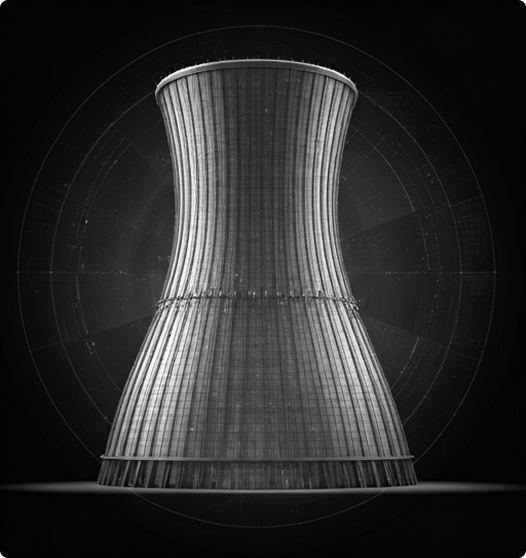
Nuclear and thermal reactors rely on complex transport equations to model heat exchange and fuel consumption. H-DES efficiently solves thermal and neutron transport PDEs, enabling high-resolution modeling of internal reactor dynamics with unprecedented speed.


Multiphase flows in oil, gas, or geothermal reservoirs present extreme computational challenges. H-DES models fluid dynamics and transport inporous media, unlocking the ability to simulate large-scale underground interactions with molecular precision.



The integration of renewable energy sources and storage introduces complex dynamic behaviors that affect grid stability and power flow. H-DES simulates power flow PDEs, including voltage wave propagation and thermal effects in lines and transformers, to analyze and optimize grid performance.


The energy sector relies on large scale simulations to design, operate, and monitor complex systems. These simulations involve multiphysics models and large numerical computations.
ColibriTD focuses on use cases where quantum computing can support scientific computing challenges in energy systems.
Key use cases include:
Reactor simulations are used to model heat transfer, fluid behavior, and physical interactions inside complex systems such as nuclear or chemical reactors.
Reservoir and porous media models are critical in oil and gas or geothermal energy. These simulations are used to understand how fluids flow through complex underground structures.
Energy network modeling focuses on grid behavior, stability, and large scale system interactions. These models require solving large mathematical systems to simulate different operating conditions.
ColibriTD develops hybrid quantum algorithms designed to explore these types of numerical problems and allow engineers and researchers to experiment with new computational approaches.
Energy systems rely on solving large systems of equations derived from physics models such as fluid dynamics, heat transfer, and electromagnetics.
As models become more complex, computation time increases and limits the number of scenarios that can be tested.
Hybrid quantum algorithms introduce new approaches to explore these problems by combining classical optimization with quantum circuit evaluations.
ColibriTD provides tools such as Hybrid Differential Equation Solver (H-DES), Multi-Platform Quantum Programming (MPQP), and the Quantum Innovative Computing Kit (QUICK) platform to experiment with these approaches on real simulation problems.
This allows simulation engineers and research teams to evaluate potential gains in computation time, cost reduction, and model precision as quantum technologies progress.
Energy networks are complex systems that involve many interconnected components such as power generation, transmission, and distribution.
Simulating these systems requires solving large scale mathematical models that describe how energy flows, how systems react to changes, and how stability is maintained under different conditions.
As networks become more complex with renewable energy integration and distributed systems, these simulations become more computationally intensive.
Hybrid quantum algorithms introduce new ways to explore these large mathematical systems by combining classical computation with quantum circuit evaluations.
ColibriTD develops technologies such as H-DES, MPQP, and the QUICK platform to allow engineers and researchers to experiment with quantum approaches on these types of models.
This allows energy companies to evaluate how quantum computing could help reduce computation time, improve simulation accuracy, and better analyze complex system behaviors as quantum technologies mature.